
Our history
We have been committed to social tourism in Switzerland for over 50 years. Our mission: to create attractive, modern youth hostels for young people, school classes and families – often together with strong partner institutions. The organisation and the architectural history evolved at the same time.
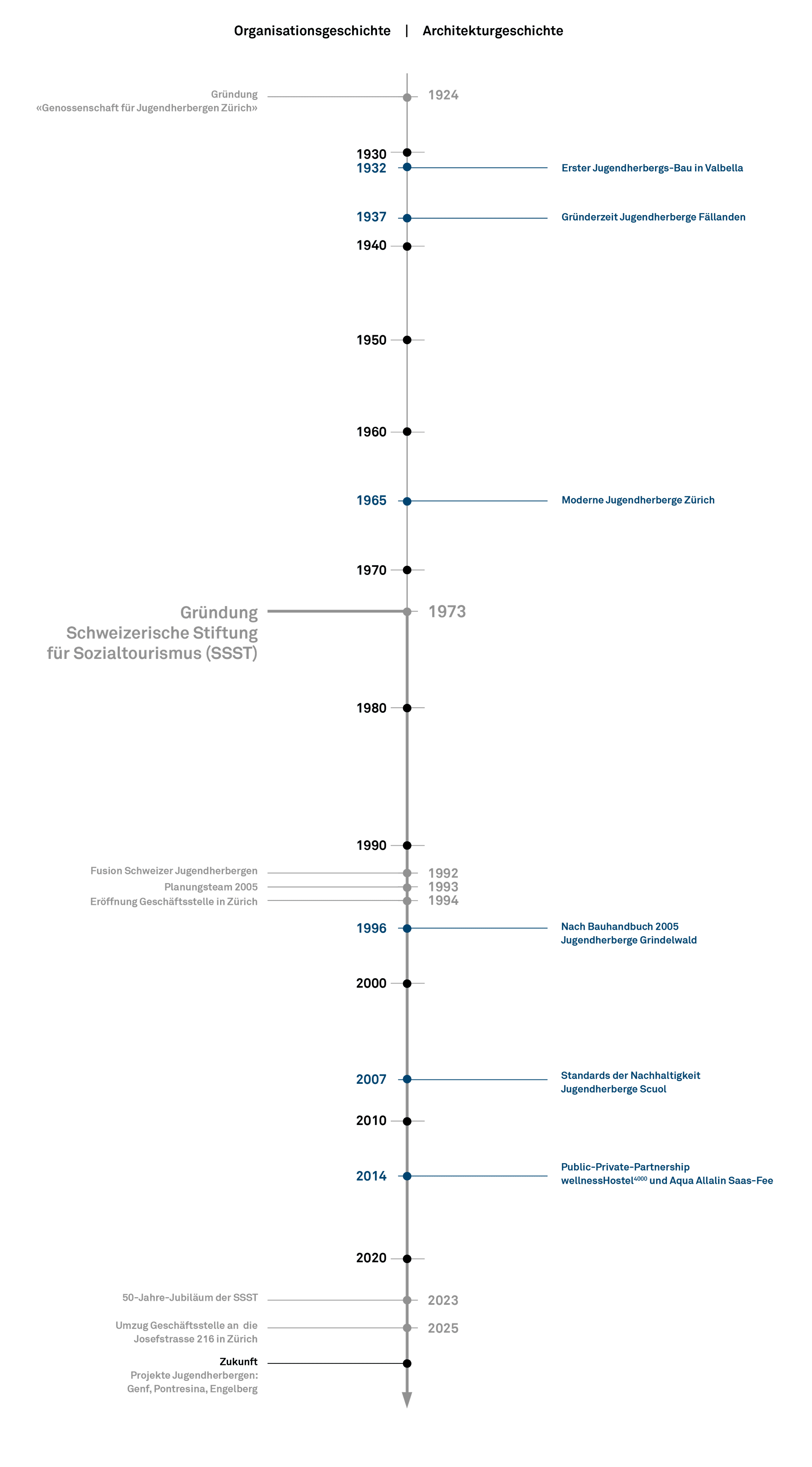
50 years of the Swiss Foundation for Social Tourism
History of the organisation
Our organisation has evolved steadily over the decades. Characterised by cooperation, foresight and clear guidelines, we establish structures that strengthen social tourism and secure the operation of the youth hostels for the long term.
Establishment
The foundation was established in 1973 by the Zurich Youth Hostels Association. As a result, the properties were removed from the unpredictable influence of the general assembly, while operations remained in the hands of the Zurich association. One of our key tasks remained to strengthen the collaboration between the 13 youth hostel organisations at the time and to drive forward a nationwide merger.
Merger of district associations
In 1992, the time had come: Most of the district associations merged to form the Swiss Youth Hostels Association. A further 18 properties were transferred to our foundation. This laid the groundwork for professional property and asset management.
“Bauhandbuch 2005”
We set standards early on: In 1993, a team of experts defined our guidelines for the construction of modern youth hostels in the “Bauhandbuch 2005” (Construction Manual 2005). The focus is on regional architecture, modern design and a mindful approach to the environment.
50th anniversary
We are celebrating our 50th anniversary at Fällanden Youth Hostel, where it all began five decades ago. A special moment to look back together and say thank you to everyone involved.
Future and outlook
The guidelines developed as part of the merger have proved their worth to this day and continue to evolve. The strategic objectives for 2024–2027 strengthen our focus on sustainability and regional partnerships. This is also reflected in the upcoming major projects in Engelberg, Geneva and Pontresina, creating added value for the local population and guests alike through strong local partnerships and forward-looking development of construction and services.

Jugendherberge Pontresina (Visualisierung des geplanten Projekts)
Pontresina Youth Hostel
Accommodation, sports centre and bouldering hall: The planned Pontresina Youth Hostel will offer added value for locals and guests.
The youth hostels through the ages
Architectural history
Our architecture is constantly evolving – always geared towards the needs of our guests.
Founding period
Opened in 1937, Fällanden Youth Hostel belongs to the first generation of youth hostels: This era was characterised by group camps, strict gender separation and a location in the middle of nature. The building designed by architect Emil Roth is considered an important work of classical modernism. Thanks to an adapted operating concept and continuous maintenance, we have been able to maintain the youth hostel in its original form to this day.

Jugendherberge Fällanden Aussenansicht
Fällanden Youth Hostel, designed by architect Emil Roth, has remained in its original form to this day.
Functional modernism
It was followed in 1965 by Zurich-Wollishofen Youth Hostel – a flagship for international youth tourism. The youth hostel sets new standards in terms of recreation rooms, room configurations, gender separation and consideration for operational requirements of a large-scale business. Following its opening, it quickly became a model youth hostel worldwide.

Reception, Zurich Youth Hostel
A flagship operation: Zurich Youth Hostel.
Based on Bauhandbuch 2005 principles
When renovating and expanding Grindelwald Youth Hostel in 1996, we implemented the guiding principles defined in the “Bauhandbuch 2005” for the first time. Comfort, privacy and the design of communal and sleeping areas were at the centre: a clear step towards a modern youth hostel.

Jugendherberge Grindelwald Zimmer
The guidelines from the Bauhandbuch 2005 construction manual were implemented for the first time at Grindelwald Youth Hostel.
Sustainability standards
We held a regional architectural competition for Scuol Youth Hostel and set new standards in terms of environmental compatibility. The building meets the Minergie-Eco standard, uses local and ecological materials and runs on a heat pump, heat recovery system and solar panels. The project’s pioneering role is underscored by the close collaboration with the regional farmers’ association and backed by several prestigious awards.

Exterior view of Scuol Youth Hostel
The highest sustainability standards and based on regional architecture: Scuol Youth Hostel.
Public-private partnership
Opened in 2014, wellnessHostel4000 in Saas-Fee is the world’s first hostel with its own wellness area and indoor swimming pool. The project was only possible thanks to the partnership with the civic community of Saas-Fee. The five-storey timber construction in accordance with the Minergie-Eco standard, powered by solar district heating and photovoltaics, has won multiple awards and is considered a flagship project for sustainable building in the Alps.

Exterior view of the Sommer wellnessHostel4000 in Saas-Fee
The world’s first wellness hostel opened in Saas-Fee in 2014.